
May 2026
The Hero Who Became the Monster: What “I Am Legend” Really Means
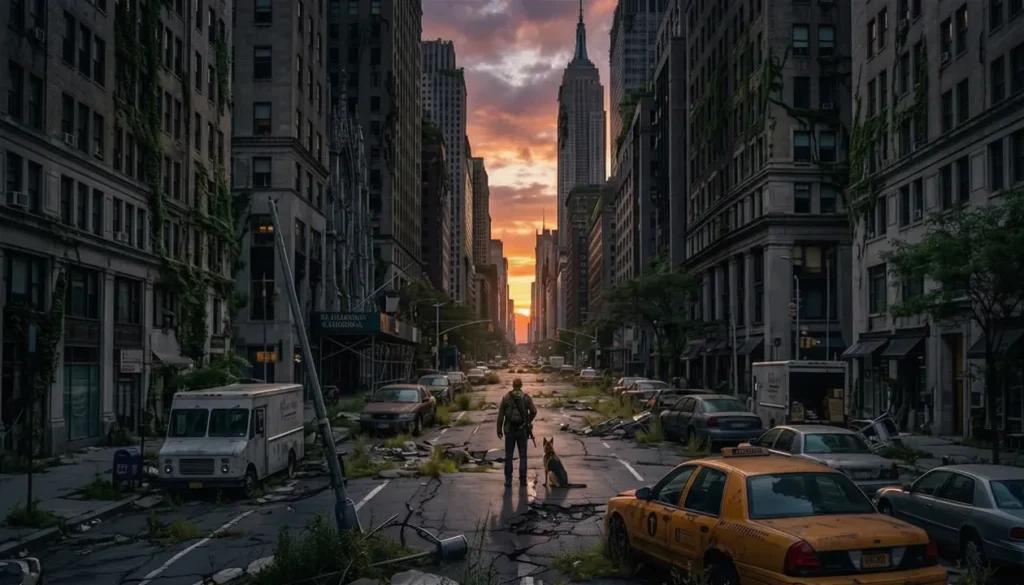
Robert Neville is the last hero on Earth or the most terrifying monster alive. Matheson’s I Am Legend flips that question into a knife.
Picture a man nailing boards over his windows as the sun goes down. Every single day. Not because he’s afraid of the dark. Because the dark is full of people who used to be his neighbors, and every one of them wants him dead. Robert Neville lives on Cimarron Street in 1976 Gardena, California, in a world where a pandemic has turned infected survivors into vampires.
They are pale, nocturnal, sensitive to garlic and mirrors, otherwise indistinguishable from the people they used to be. And Neville is the only man standing on the other side of that line.
Richard Matheson wrote the book in 1954 while working day shifts at the Douglas Aircraft Plant in Santa Monica. He developed the concept after watching the 1931 film Dracula years earlier. His thought, as he later described it in an interview, was simple: if one vampire is frightening, what happens when the whole world is full of them?
That single question cracked open everything we thought we knew about who the monster is.
The Man Who Built the Wall
Matheson was born in 1926 in Allendale, New Jersey, to Norwegian immigrants, and started writing at age seven despite little encouragement from his parents. He served in the U.S. Army during World War II, then earned a journalism degree from the University of Missouri. These aren’t incidental facts. A man who watched the world tear itself apart in the 1940s and then wrote science fiction in the shadow of the Cold War was not simply writing about vampires. Critics have noted that the novel’s futuristic Los Angeles alludes directly to the Cold War, an era defined by legitimate fears of nuclear annihilation.
He dropped all of that anxiety onto one man in one house with the curtains nailed shut.
The novel is very much an examination of human loneliness, and the pressure that solitude puts on one’s sanity. Neville drinks. He plays old records too loudly. He drives through daylit streets impaling sleeping vampires with wooden stakes, and he comes back to a house full of silence and garlic. He repeats this until it stops feeling real.
This is not a horror novel about monsters outside. It is a horror novel about what happens to the person inside.
The Hero, Seen From One Side
For the first three-quarters of the book, the framing is clear. Neville is the last human. He is the survivor. He studies the bacterial science behind vampirism, fortifies his home, fights back. One of the central themes of the book is that everyone is an antagonist to someone else. But Matheson lets you forget that for a while. He lets you root for the man.
Neville is courageous, relentless, and deeply alone. He buries his wife and watches her come back as something else. Readers often report a strong empathetic bond with the main character, whose loss of his wife and daughter to the virus is portrayed in a flashback mid-novel. Matheson earns that bond deliberately. He needs you on Neville’s side before he pulls the rug. Because the rug does get pulled.
When Ruth Walks Through the Door
A woman named Ruth appears in daylight, which should be impossible. Neville is immediately suspicious, then immediately desperate not to be. He hasn’t seen a living human being in years. After testing her blood, he discovers she is infected with the vampire pathogen. She knocks him unconscious and escapes, leaving a note explaining that she is part of a new society of living vampires, people who have developed medication to manage the disease and are slowly building a new civilization.
This is the moment the novel changes its genre.
The knowledge switches Neville’s perspective, and he realizes his presence threatens them. He is not the last defender of humanity. He is the thing that sneaks into their homes while they sleep, drives a wooden stake through their hearts, and walks back out into the sun. He has been doing this for years. Systematically. To people who had names and families.
He killed so many of them that they found him terrifying. What he discovers at the end is that he wasn’t just killing monsters, but intelligent beings. He was committing genocide.
The Last Line of the Book
Neville wakes in a cell. Ruth explains that the new society is going to execute him. In their eyes, he is a horrifying creature who has mercilessly killed their kind for three years. She offers him poison capsules to make his death less painful. As he faces his execution, Neville realizes the truth: he is the monster.
He looks out the cell window. He sees the infected staring back at him with the same fear and hatred he once felt for them.
And then comes the last line. The title. “I am legend”.
The suggestion is that, to the vampires, Neville is a terrifying supernatural creature who needs to be destroyed before he can kill again. He has finally seen the world from the perspective of the Other, and understood that he, too, is the foreign, alien being. LitCharts Long after he is gone, their children will tell scary stories about the human who crept through the daylight and murdered whole families in their sleep.
The book may as well have been titled “I Am the Monster.” Every society has its myths, its things that go bump in the night. For them, those things had been vampires. Now it is him.
The Hero Is Always the Hero of His Own Story
That is what makes this book remarkable and, honestly, unsettling in a way that no film adaptation has quite captured. The 2007 Will Smith version does Neville the disservice of making him conventionally heroic. Matheson never wrote stories about heroes. None of his protagonists are heroic. They are ordinary, frightened, often wrong.
Over the years, various critics and scholars have interpreted the novel as a metaphor for the experience of marginalized groups. The vampires could represent any minority group that has been demonized and treated as the Other. Matheson wrote in 1954 America. He understood what it meant to designate a group as something less than human and treat that designation as permission.
The novel discusses moral relativism, the evolution of the horror genre, and loneliness. Those three things are, in this book, inseparable. Neville’s loneliness convinces him his moral frame is the only valid one. The horror is not the vampires. The horror is how logical his violence felt the entire time he was committing it.
The new society does not hate him because he is evil. They fear him for the same reason any group fears the thing that has been hunting them. He was their Dracula. Their boogeyman. The story grandmothers tell to keep children inside after dark.
He earned that legend. Every morning, for years, with a wooden stake in his hand.